About this pair
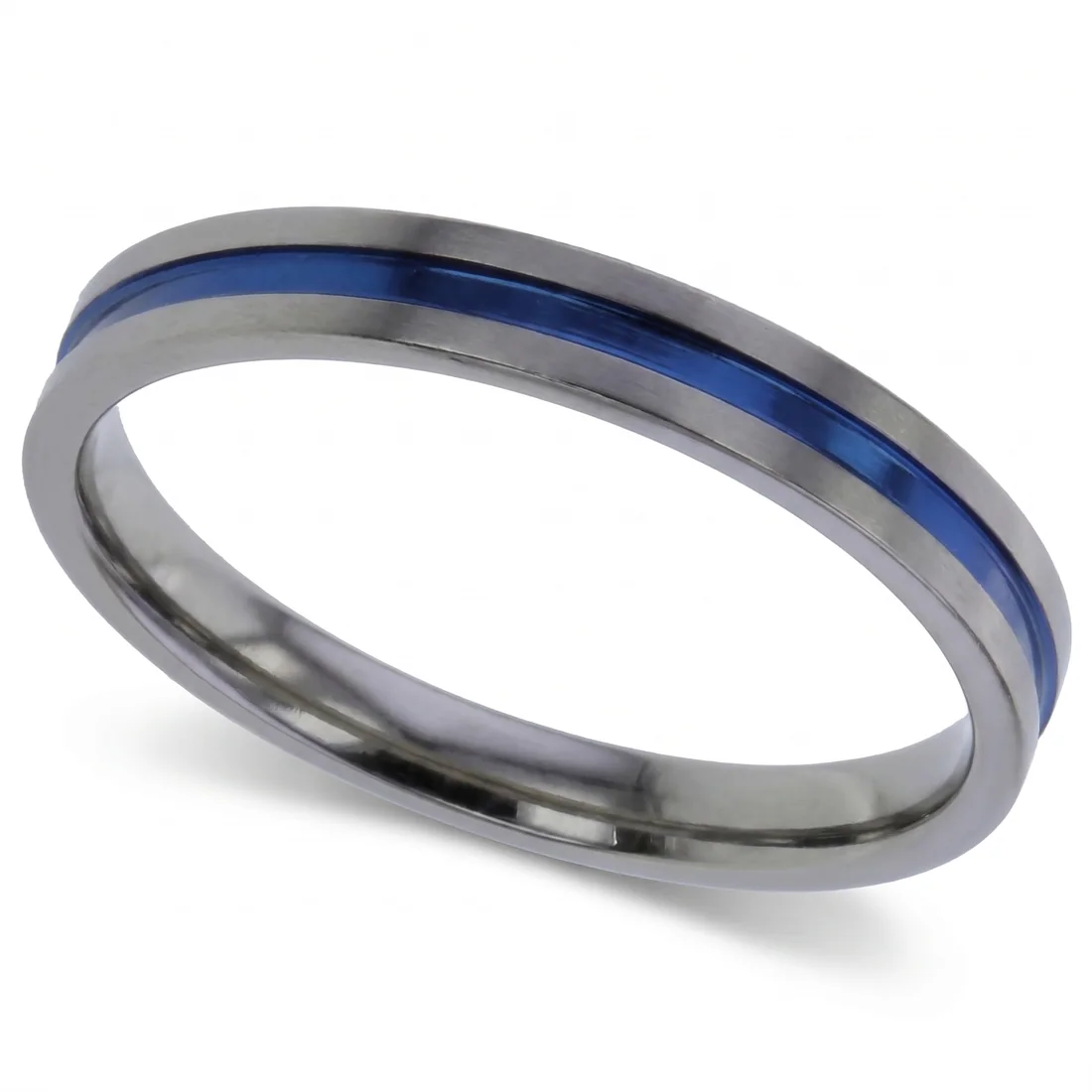
Anodised channel and Hammered, anodised, side by side
Colour grown from the metal itself links these two, and the surface beneath it is what sets them apart. Anodised channel holds its colour in a neat stripe down the centre of a satin band, with natural zirconium on either side. Hammered, anodised is struck by hand first and coloured afterwards, so the oxide film follows every dent and the shade pools and lifts across the surface rather than sitting flat. On two hands, one ring shows colour as a line and the other as a field.
Each ring on its own
Anodised channel offers five colours, dark blue, purply blue, bronze, pink and yellow, in satin zirconium from 4 to 10mm. Hammered, anodised is coloured all over in dark blue, bronze or pink, and its hammer marks are individual to the ring. Both sit lightly on the hand and suit sensitive skin. Bought singly, the channel is the more restrained ring and the hammered one the least repeatable thing in the range.
The two rings compared
Hers and his, on the same measures | Hers | His |
|---|
| Ring | Anodised channel | Hammered, anodised |
|---|
| Metal | Anodised zirconium | Anodised zirconium |
|---|
| Width | 4 to 10mm | 4 to 10mm |
|---|
| Finish | satin | hammered |
|---|
| Weight | About 3.2g at 6mm, est. | About 3.2g at 6mm, est. |
|---|
| Surface hardness | Mohs 8.5 | Mohs 8.5 |
|---|
| From | £285 | £285 |
|---|
Choosing between the options
Three shades are shared by both designs: dark blue, bronze and pink. Matching colours means picking from those, while purply blue and yellow belong to the channel alone. In both rings the colour is a surface finish, which abrasion can change, so the coloured face is happiest on hands that avoid rough work. Colour all over on both hands means the hammered design twice.
More pairs on his and hers wedding rings. Wondering whether your rings need to match at all?
Mixing metals in wedding rings covers it.