7 minute read
Can you mix metals in wedding rings?
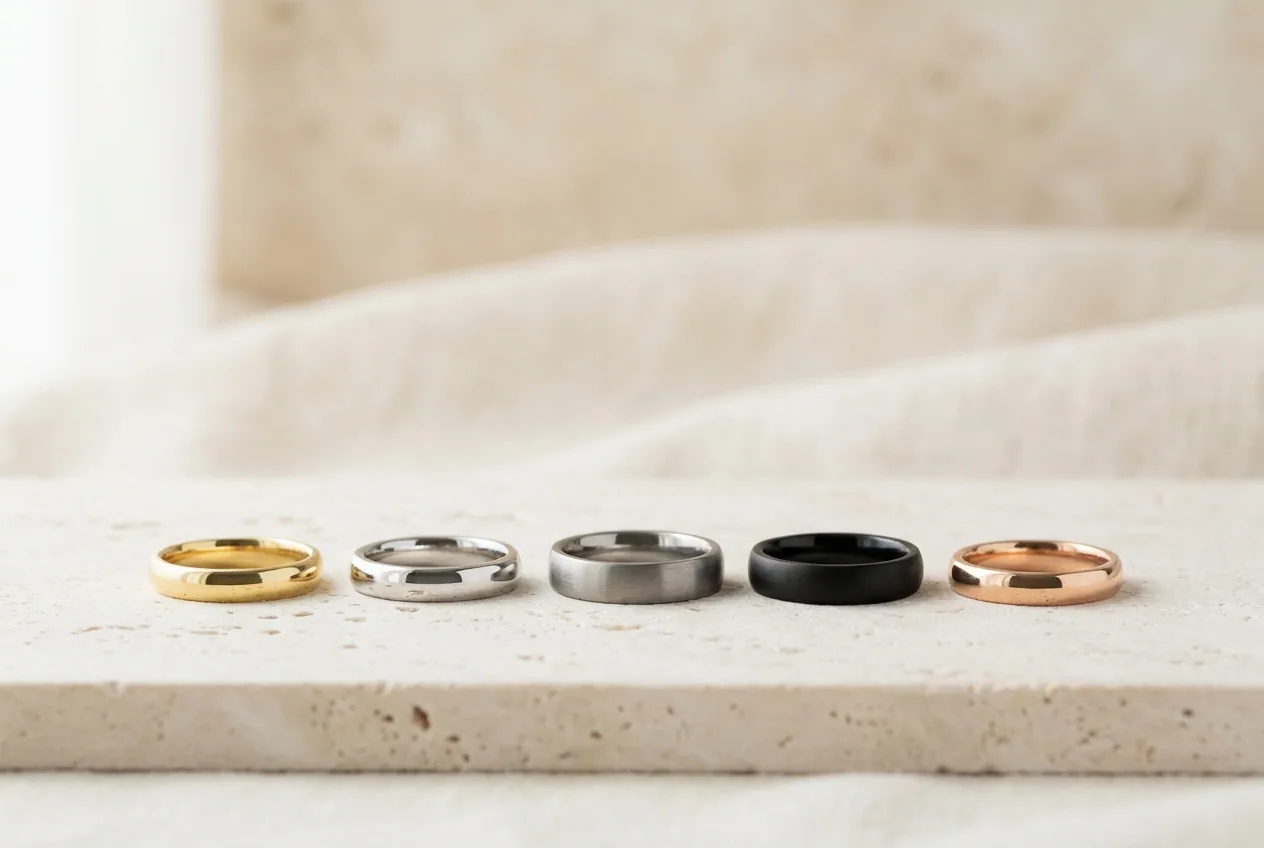
Yes. The useful question is where the metals meet: across two hands, against each other in a stack, or permanently joined inside one ring.

There are three different versions of this question
Two partners can choose different metals with no practical consequence because the rings never touch. A gold band and a titanium band do not need the same colour, weight or maintenance routine to belong to the same marriage.
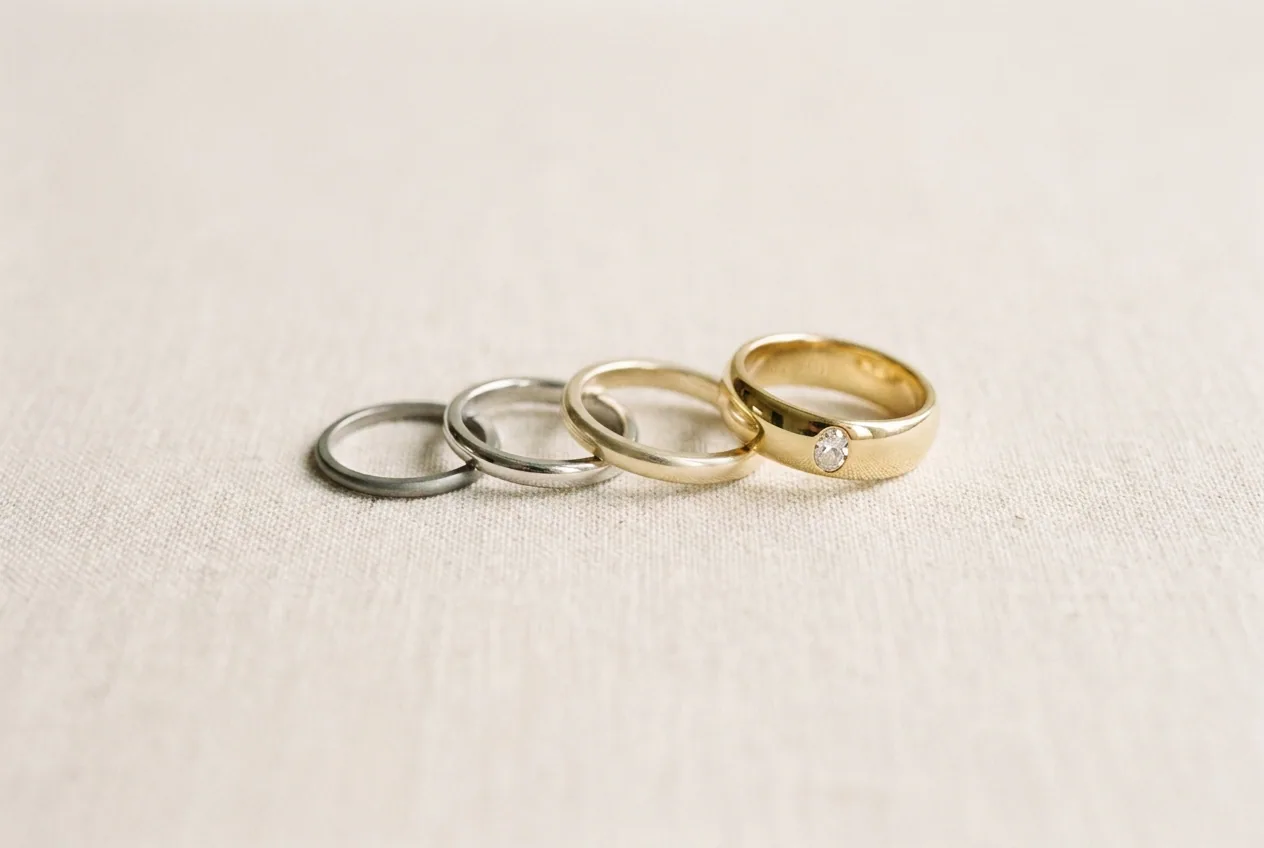
An engagement ring and wedding band worn on one finger are different: their edges move against each other as the hand moves. A single ring made from two metals is different again, because its hallmark, resizing and repair depend on how those metals were joined. Treating all three as one styling question hides the decisions that matter.
Can different metals damage each other in a stack?
They can. GIA warns that stacking rings can cause scratches and wear, especially with different metals. But a single hardness number for gold or platinum cannot tell you whether your particular pair is suitable. GIA's technical guidance distinguishes platinum alloys with different working properties; its gold guidance explains that alloying changes the metal's strength as well as its colour.
Use that as a reason to inspect the actual rings together. Ask a jeweller to check where the wedding band's edge sits relative to the engagement-ring setting. Matching the colour is not a substitute for checking the contact, and a contrasting colour is not itself a reason to reject a pair.
Gold with platinum, white gold or rose gold
Yellow gold and platinum: treat this as a contact-and-fit decision. GIA gives gold beside platinum as an example where wear needs attention. Bring the engagement ring to the appointment and ask the jeweller to assess the proposed band alongside it, rather than approving two metal names in isolation.
Yellow gold and white gold: both are gold alloys, although their colours differ. White gold is usually rhodium plated, according to GIA, and that coating can wear away. Ask whether the sample is plated and what its underlying colour looks like. A bright white finish today does not promise an identical colour beside your yellow-gold ring indefinitely.
Yellow gold and rose gold: rose gold gets its colour from alloying gold with copper and silver. Choose the contrast you enjoy, then check the full specification and fit. The shared word gold does not establish that two rings use the same alloy or have the same working properties.
Silver and white gold: a similar colour does not mean identical care. GIA describes silver as more susceptible to scratches and dents and prone to tarnish. If you want to include an existing silver ring, ask about its condition and maintenance before making it part of an everyday bridal stack.
Does a spacer ring solve the problem?
GIA suggests a buffer ring as one way to separate mixed metals. It also notes that several rings on one finger can make the fit tighter. A spacer is therefore a design option to assess with the complete stack, not an automatic extra purchase or a guarantee against damage.
At the appointment, try the pair both with and without the proposed spacer. Ask the jeweller to show you what it separates and whether any setting still touches a neighbouring ring. Decide whether you like the additional width before choosing the finish. If the combination only works when held in a particular position for a photograph, ask to see another arrangement.
Our suggested alternatives to discuss are a different band profile, wearing the rings on separate fingers, or keeping one for occasions. Choose the arrangement you would actually enjoy wearing. Do not buy a spacer solely because an online chart calls one metal harder than another.
Two colours do not always mean two solid metals
A mixed-metal ring may be two solid precious metals joined together, a solid precious inlay set into titanium or zirconium, or a plated surface over another metal. Those constructions look similar in a photograph and behave very differently over time.
A solid gold section and a gold-plated surface are different specifications. Plating is a surface layer; GIA notes that worn rhodium plating on white gold may need renewing. Before buying, ask what is solid, what is a surface treatment, how deep an inlay is, and whether the maker can repair the join. The answer matters more than the phrase two-tone.
For one ring with contrasting colours, the following Trothe designs show three ways to use solid gold inlays. They are examples of construction and colour, not pre-approved companions for an engagement ring. Open the product page to compare its available widths, finish and selected price; check the complete design with the maker if future resizing matters.
Gold line, titanium: A solid 9ct gold inlay set flush into a titanium band, with yellow, rose or white gold options. Start here if you want to compare a single gold accent against grey titanium. Choosing white gold changes the contrast, not the titanium base.
Gold line, black: Solid 9ct yellow gold set into black zirconium. Compare this with the titanium version if a dark band and a yellow line appeal to you. Read the zirconium care and resizing guidance before choosing; the gold inlay does not make the whole ring behave like a gold band.
White and rose gold lines: Two solid 9ct gold inlays, one white and one rose, in a titanium band. This gives you two gold colours in a single ring. It is a titanium ring with precious inlays, rather than a band made entirely from two colours of gold.
The hallmark tells you which parts are precious
Current British Hallmarking Council guidance allows more than one precious metal in one article. The full hallmark is normally the least precious metal in the official order of silver, palladium, gold and platinum, with a separate fineness mark on the higher precious-metal part. Two standards of the same metal, such as 9ct and 18ct gold, are treated differently: the lower standard is hallmarked.
A precious metal combined with a base metal such as titanium can also be hallmarked. The precious section carries the hallmark and the mark includes +METAL, while the base-metal part must be visibly distinguishable. A hallmark therefore verifies the precious part; it does not turn the whole ring into gold or platinum.
These are the general rules; the guidance also covers exceptions for small components. Gold-plated silver is hallmarked as silver, rather than as a solid gold-and-silver mixture. Use the hallmark decoder to interpret the marks, and ask the seller or assay office about an ambiguous combination.
Resizing follows the construction
Resizing requires knowing the actual construction and alloys. GIA warns that using incompatible platinum materials during sizing can cause the work to fail. For a ring joining gold and platinum, ask the workshop to assess both components. For a gold inlay in zirconium, ask the maker to assess the entire design; GETi says zirconium resizing is difficult, although not entirely impossible.
Do not accept a blanket yes because one component is gold. Ask whether this exact construction can be resized, by whom, and by how many sizes. If the answer depends on sending it back to the original workshop, record that before the workshop name is lost.
Make the contrast look intentional
For a starting point, try unequal proportions: a narrow gold line through a broad dark band, or a slim platinum wedding ring beside a larger yellow-gold setting. Compare that with equal proportions and decide which feels right on your hand.
Finish can do as much work as colour. Brushed titanium beside polished gold reads more clearly than two polished white metals that are almost, but not quite, the same shade. Repeat one detail once (the gold of the setting in a centre inlay, or the platinum colour in a spacer) and stop there.
What to take to a mixed-metal ring appointment
Bring the ring you already wear, its paperwork if available, and a note of any previous resizing, repairs or plating. Our suggested starting question is: can you assess this complete combination for daily wear? That keeps the discussion about your rings rather than a general promise about gold or platinum.
Ask to record the metal and fineness of each part, any coating, who handles future work, and the proposed approach if your size changes. For a two-tone ring, ask the seller to point out which visible areas are solid sections, inlays or plating. Keep the specification with the receipt so a future repairer has more than a photograph to work from.
Use the band-width guide below to compare proportions before an appointment and the metal chooser to narrow your preferences. The ring-weight calculator estimates plain-band weight; it does not certify a mixed-metal stack's fit or wear. Leave the final compatibility assessment to the jeweller with both rings in hand.
Can you use your own metal for a wedding ring?
Yes, with a jeweller who remakes customer gold, and it is a lovely way to carry a family ring into a marriage. It is done in one of three ways: your metal is melted and remade into the new ring, its value is credited against new metal, or only the stones are reused. Only the first puts your own gold in the finished ring, so that is the one to ask for by name.
The new ring is hallmarked as a new piece, because an old hallmark does not carry across to a remade article. If you would rather keep the heirloom as it is, wear it beside a new band or on the other hand, and the stacking advice above applies to the pair.
Can a wedding ring be made from your own gold?: The three routes a jeweller can take with heirloom metal, the questions that settle which one you are getting, and how it differs from recycled gold.
The short answer for each situation
Different metals across two partners: choose independently. Different metals touching on one finger: have the combination assessed, including any proposed spacer. Two metals inside one ring: check what is solid, how it is hallmarked, and whether that exact construction can be resized.
Matching is a visual choice. Wear, hallmarking and repair are engineering questions. Keep those separate and mixed metals become straightforward.
Mentioned: titanium, precious inlay, 9ct gold, 18ct gold, platinum 950.