6 minute read
Black, blue and yellow diamond wedding rings: what a treated diamond is
Black diamonds are real diamonds and so are blue and yellow ones. Every coloured diamond in our bands is treated to reach its colour and each ring's page says so. Here is what treated means, whether the colour lasts and how a small coloured diamond looks set into titanium.
Are black diamonds real diamonds?
Yes. A black diamond is carbon with the same crystal structure and hardness as a colourless diamond, which is how GIA, the Gemological Institute of America, describes it. What differs is why it looks black.
A natural black diamond is dark because it is full of tiny mineral inclusions such as graphite. GIA says most black diamonds are treated instead. A grey or brown diamond that is heavily included or fractured is heated until graphite forms in the fractures, or irradiated to a green so deep that it looks black.
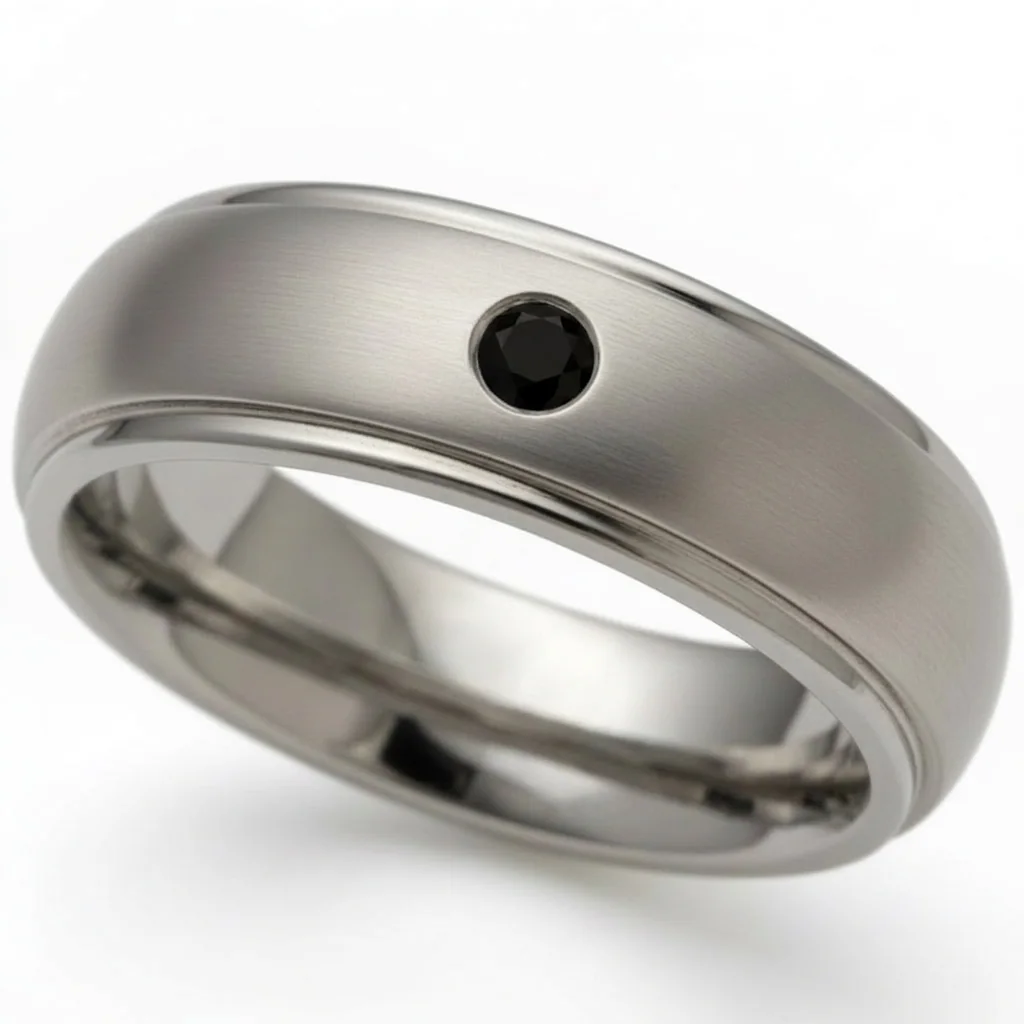
The black diamond in our titanium band is treated and its page says so. It is one 6 point stone, 2.5mm across. Treatment changes the colour and leaves the stone what it was: diamond, at 10 on the Mohs scale.
Black diamond, titanium: One treated black diamond set into a domed titanium band.
Men's diamond wedding bands: How many stones, which metal and how they are set.
What does treated diamond mean?
It means a real diamond whose colour has been changed by a process applied to the stone. The word describes how the colour got there.
GIA describes four ways it is done. Irradiation can produce blue, green, yellow, black and other colours. Annealing is controlled heating and cooling, often used after irradiation and very common for black diamonds. High pressure, high temperature treatment (HPHT) can turn some brownish diamonds yellow or green. A coating is an ultra thin layer over the surface that masks the colour beneath.
In nature the colour comes from something extra in the crystal: mostly traces of boron in a blue diamond and nitrogen in a yellow one. Natural fancy colours are rare. GIA's guide to blue diamonds says treated ones typically cost significantly less.
GIA's advice is that every treatment is disclosed before you buy. Each of our rings with a coloured diamond states it on its own page, because a treated diamond is a different thing from an untreated one.
Diamond wedding rings: Every band with diamonds set into it, white and coloured.
Does the colour of a treated diamond last?
With the stable treatments, yes. GIA describes irradiation as stable to regular wear and calls annealing and HPHT stable treatments. A coating is the exception: GIA says coatings are not permanent and can scratch and wear off over time.
Heat is the one thing to know about. GIA notes that irradiated or annealed diamonds can be sensitive to heat and advises telling a jeweller that a diamond is treated before any repair. The caution concerns the heat of a repair. It is not about daily wear.
This is GIA's general account of treated diamonds. Our pages state that each coloured diamond is treated and do not name the method.
Does a black diamond show better in titanium or black zirconium?
Titanium. A black diamond needs a pale band around it to be seen. Against light grey titanium it reads as a dark point. In a black band it would have little to stand out against.
Every coloured diamond in our range is set in titanium: black, blue and yellow alike. Our black zirconium bands carry white diamonds, which is the same contrast reversed.
A black diamond shines more than it sparkles. GIA describes black diamonds as typically opaque and cut for a sleek surface shine over brilliance. The blue and yellow 6 point diamonds in our bands are round brilliant cuts.
Width changes the effect too. All five bands are made from 6mm to 10mm. At 6mm or 7mm a stone fills more of the face. At 9mm or 10mm it becomes a single point on a broad dome.
Black zirconium or titanium: Weight, wear and price side by side.
One diamond, black: A white diamond set level with a black zirconium band.
Band width guide: How each width looks and feels on the hand.
Which men's black, blue or yellow diamond wedding band should you choose?
Choose by how much colour you want to see. One stone is the quietest. Black diamond, titanium sets a single black diamond into a domed satin band with shoulder cut edges. Yellow diamond, titanium does the same with one yellow diamond, the band finished in satin and polish.
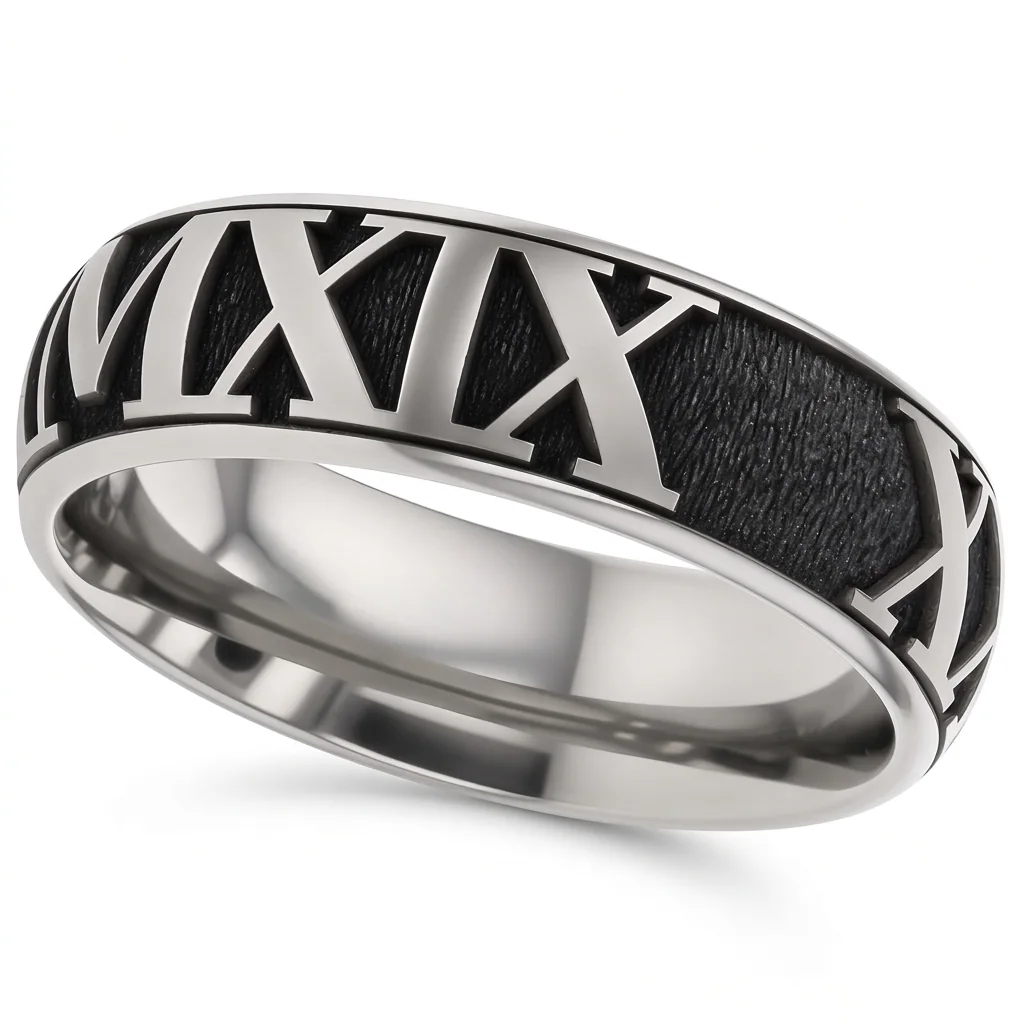
For a man's blue diamond wedding ring there are three. Three blue diamonds spaces its stones wide apart across a satin dome, 0.18 of a carat together. Blue and white diamonds puts one white diamond between two blue ones and is made polished or in a straight or angled satin. Roman numerals, two blue diamonds engraves your date on the outside with a 3 point blue diamond on either side of it.
The Roman numeral band is made with your date, so it is yours alone and cannot come back for a change of mind. All five are titanium, which is light and hypoallergenic.
Three blue diamonds, titanium: Three treated blue diamonds across a titanium dome.
Yellow diamond, titanium: One treated yellow diamond in a shoulder cut titanium band.
Roman numeral wedding rings: What they mean, which date to choose and the styles to pick from.
Can a coloured diamond band be an engagement ring?
Yes. Three of ours are sold as an engagement ring, a wedding ring or both: Three blue diamonds, Blue and white diamonds and Yellow diamond, titanium. The stones are set into the band with nothing raised, so one ring can be worn from the proposal onwards.
Blue and white diamonds sits closest to a traditional engagement ring: a white centre stone with a blue diamond on either side, a small trilogy. The black diamond band and the Roman numeral band are sold as wedding rings.
Engagement rings: Diamond bands to wear as an engagement ring, a wedding ring or both.
Do men wear engagement rings?: What men choose and how one ring can do both jobs.
How do you look after a black, blue or yellow diamond ring?
With warm water, mild soap and a soft brush. GIA's routine for a coloured diamond is a few drops of mild dish soap in warm water, a soak of 10 to 15 minutes, a gentle scrub with a soft toothbrush, a rinse and a pat dry with a lint-free cloth. Warm soapy water is all titanium needs too.
For a black diamond GIA advises skipping ultrasonic and steam cleaners and avoiding hard knocks. The fractures and inclusions that make a diamond black can also make it more likely to chip if it is struck sharply. Setting a stone into the band protects it well, but no setting makes a diamond immune to a hard blow.
If a jeweller ever works on the ring, say that the coloured diamonds are treated before they start.
Caring for your ring: Three everyday habits and a short note for every metal and stone we make.
How to look after a wedding ring: Cleaning, storing and when to take a ring off.
Mentioned: titanium, black zirconium.