5 minute read
The claddagh ring: what it means and how to wear it
Two hands for friendship, a heart for love and a crown for loyalty. The hand you wear it on and the way the heart points are said to show whether you are single, taken, engaged or married. Here is the tradition, where it comes from and how much of it is a rule.

What does a claddagh ring mean?
Each part stands for something. The two hands are friendship, the heart is love and the crown above it is loyalty. Together they make the motto often given with the ring: let love and friendship reign.
The design belongs to a much older family of rings called fede rings, from the Italian for hands joined in faith, which go back to Ancient Rome. The claddagh adds the heart and the crown.
How do you wear a claddagh ring?
The tradition, as it is usually told, reads the hand and the direction of the heart together:
On the right hand with the heart pointing towards your fingertips, you are single and your heart is open. On the right hand with the heart pointing towards your wrist, you are in a relationship: someone has captured your heart. On the ring finger of the left hand with the heart pointing out, you are engaged. On the left ring finger with the heart pointing in, towards the wrist, you are married.
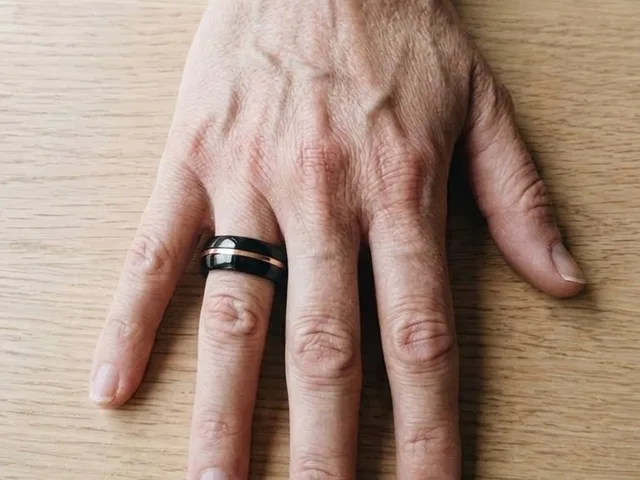
On a band such as ours, where the claddagh is cut into the surface, the direction is simply which way round you slide the ring on. Turning it over moves you from one meaning to the other, which is the whole charm of it.
Which hand does a wedding ring go on?: The British convention and the countries that wear it on the right.
Is there a rule about wearing a claddagh ring?
Not a written one. The folklore around the ring is relatively recent rather than ancient, it was passed on mostly by word of mouth and it varies from place to place in Ireland and among Irish families abroad. Very little was written down in Irish about it.
So treat the four ways of wearing it as a custom you can follow, not a test you can fail. A married person can wear a claddagh on the right hand beside an engagement ring on the left. That is a perfectly good way to wear it too.
Where does the claddagh ring come from?
From the Claddagh, a fishing village just outside Galway, where the ring in its modern form was made from the seventeenth century. The name claddagh ring itself was not used before the 1830s.
The story most often told is of Richard Joyce, a Galway man captured by pirates, sold to a goldsmith in Algiers, who learned the trade and came home to make the first claddagh ring. Historians treat the captivity as a legend that cannot be proved. The ring is real enough: the oldest known claddagh, made around 1700 and attributed to Joyce, sold at Sotheby's in 2020 and was bought by Galway City Museum.
Can a claddagh ring be a wedding ring?
Yes. That is how it is most often used: as an engagement ring or a wedding ring. In some families a claddagh is passed from mother to eldest daughter. Worn on the left ring finger with the heart pointing in, it is a wedding ring by its own tradition.
As a wedding ring the practical questions are the same as for any band. Choose a metal you can wear every day, a width that suits your hand and a size measured on the finger you will wear it on. Our claddagh band is cut into black zirconium, 4mm to 10mm, so the hands and heart read clearly against the black. Engraving inside is free.
Claddagh, black: Hands, heart and crown with knotwork either side, cut into black zirconium.
Is black zirconium good for a wedding ring?: How the black is grown and how it wears.
What goes well with a claddagh ring?
Celtic knotwork, which most claddagh rings already carry. If one of you wants the claddagh and the other wants something plainer, a Celtic band in titanium or black keeps the same knot without the hands and heart. An ogham band, written in the early Irish alphabet, is the other Irish choice: it can carry a name in a script almost nobody reads.
Celtic wedding rings: What the knotwork means, the trinity knot and ogham.
Mentioned: black zirconium.