About this pair
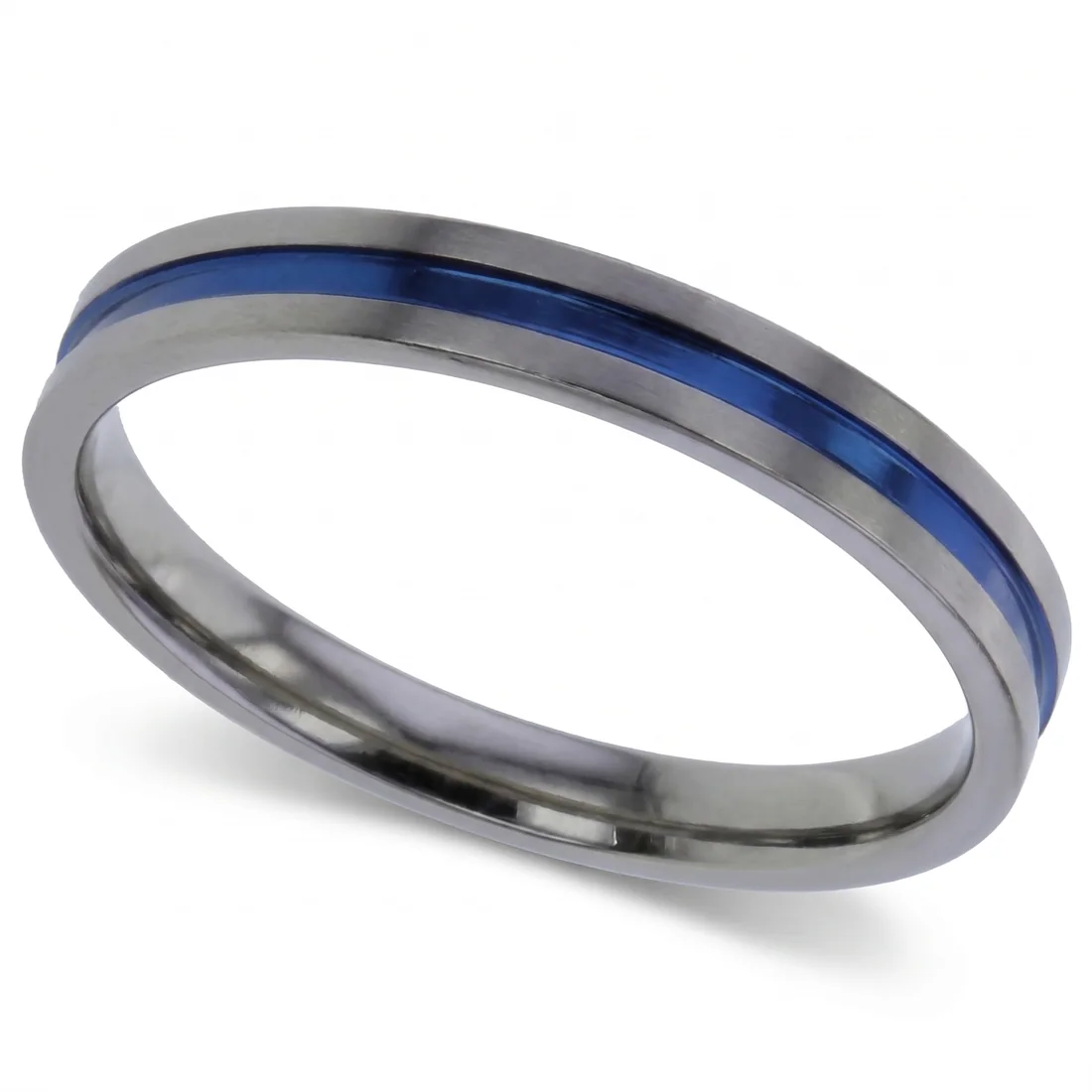
Anodised channel and Anodised bevels, side by side
These two are the same idea turned inside out. Anodised channel runs a band of colour down the centre between natural metal edges; Anodised bevels keeps the centre natural and puts the colour on the edges, so it frames the ring rather than splitting it. Worn on two hands, one ring shows colour as a stripe and the other as an outline, and in the same shade the link between them is obvious at a glance. In each, the colour is zirconium's own oxide, grown rather than applied, and it shifts slightly as the hand turns.
Each ring on its own
Anodised channel is a satin zirconium band from 4 to 10mm with the colour down the middle, in dark blue, purply blue, bronze, pink or yellow. Anodised bevels offers the same widths and the same five colours, with fine anodised lines at the edges instead, and was drawn to sit beside the channel in a slimmer width. Neither troubles skin that reacts to nickel, both are light for their size, and each is complete on its own.
The two rings compared
Hers and his, on the same measures | Hers | His |
|---|
| Ring | Anodised channel | Anodised bevels |
|---|
| Metal | Anodised zirconium | Anodised zirconium |
|---|
| Width | 4 to 10mm | 4 to 10mm |
|---|
| Finish | satin | satin |
|---|
| Weight | About 3.2g at 6mm, est. | About 3.2g at 6mm, est. |
|---|
| Surface hardness | Mohs 8.5 | Mohs 8.5 |
|---|
| From | £285 | £285 |
|---|
Choosing between the options
The first decision is colour, and the pair works in one shade or two: matched colours read as a set, while different colours still share the same construction. The second is width. The bevels design was made to be the slimmer of the two, and on a wide band it is the quieter. For colour on one ring only, either of these sits well beside Plain black zirconium instead.
More pairs on his and hers wedding rings. Wondering whether your rings need to match at all?
Mixing metals in wedding rings covers it.