5 minute read
Do wedding rings have to match?
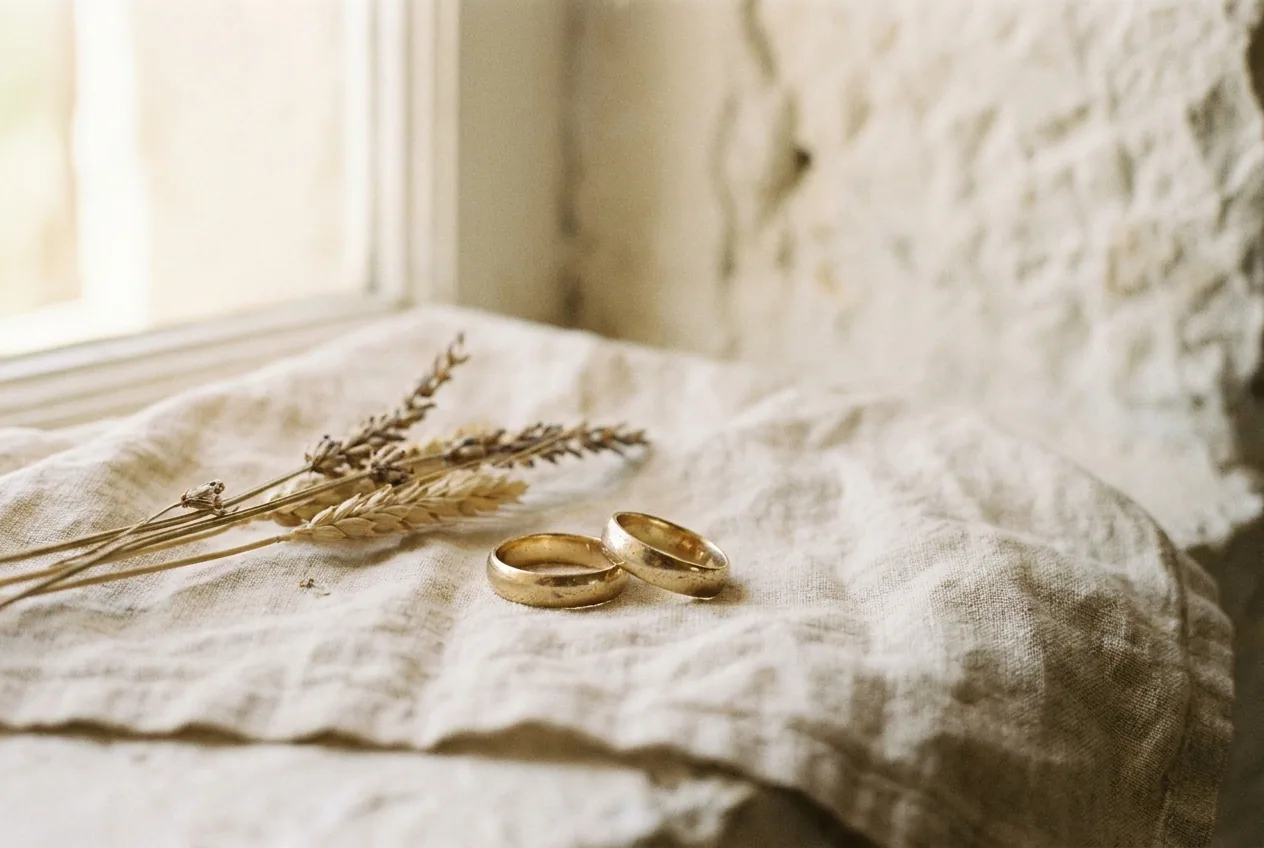
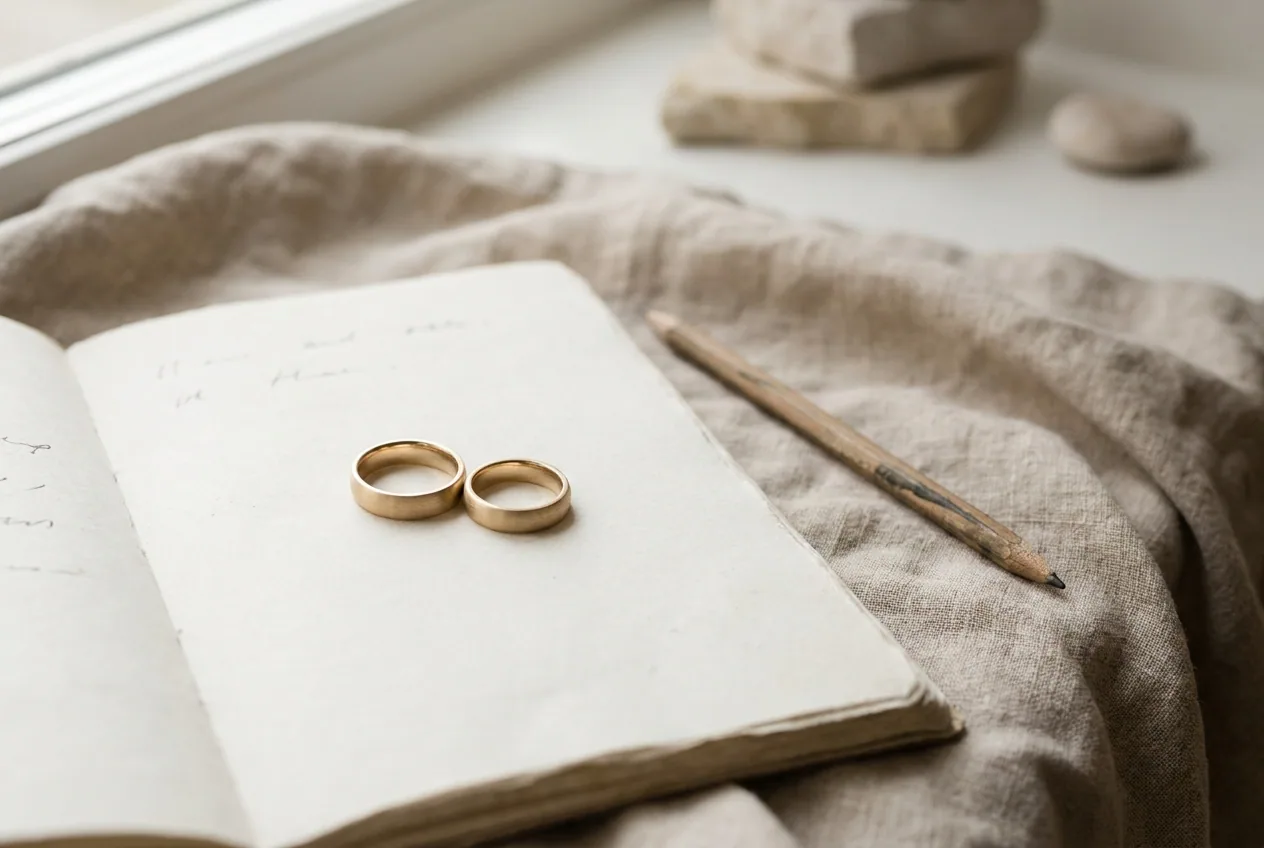
No. Your rings live on two different hands and never touch, so each of you can choose the metal, width and finish that suits you. If you want them to look like a pair, share one thing and let the rest differ: that reads as chosen together without looking like a uniform.

Do wedding rings have to match?
No. Nothing in a British wedding ceremony says two partners' rings must match. Many couples choose quite different rings. The rings sit on two different hands, so unlike an engagement ring and a band on one finger they never wear against each other. Each of you can choose for your own hand, your own work and your own taste.
What most couples want is something narrower than matching: rings that look as if they were chosen together. That takes one shared element, not two identical rings.
Wedding rings for same-sex couples: Matching, engagement rings for one or both of you and buying together.
How do couples coordinate rings without them looking identical?
Share one thing and let the rest differ. The four that work best are the metal, the finish, a detail and the profile.
The metal: both in titanium, or both in yellow gold, at two different widths. The finish: brushed or satin on both, even when one ring is gold and the other titanium, because finish is what the eye reads first after colour. A detail: a line of rose gold set into both bands, a hammered texture on both or the same date in Roman numerals. The profile: both flat with crisp edges, or both softly rounded.
Repeat that one element and stop there. Two rings that share a metal, a finish, a width and a pattern stop reading as a pair and start reading as a uniform, which is the look most couples are trying to avoid.
Ring sets: Rings designed or chosen to be worn as a pair, either ring on its own or both.
His and hers rings: Rings made to be worn as a pair.
Celtic wedding rings: What the knotwork means, the trinity knot and ogham.
Should both wedding rings be the same width?
Usually not. A band that suits a slim finger can look lost on a broad one, while a band that suits a broad finger can swamp a slim one. The usual pattern is a narrow band beside an engagement ring and a wider band worn alone: 2mm or 3mm is the classic width beside an engagement ring, with 4mm to 6mm for a band worn on its own.
Choosing one design at two widths is the simplest way to match. Most of our designs are made in several widths, so the same ring can come as a slim band for one of you and a broader one for the other. Each ring page lists the widths it is made in.
Before you settle on two widths, the free ring try-on draws a ring onto a photo of each of your hands at the width you choose.
Band width guide: Every width in millimetres and grams, with how each reads on the hand.
Ring try-on: See a ring on a photo of your own hand, free.
Do wedding rings need to be the same metal?
No. Two partners can wear different metals with no practical consequence, because the rings never touch. A yellow gold band and a titanium band belong to the same marriage as surely as two gold ones.
Different metals let each of you choose for how you live. Someone who works with their hands may want titanium, which is light and never needs replating, while their partner chooses gold. A shared finish or detail is what ties the two together.
Metal matters on one finger, where a new band sits beside an engagement ring. A pair in two metals on one hand is worth looking at together. Our guide to mixing metals covers how.
Do wedding rings have to be gold?: What else works and what you give up.
Can you mix metals in wedding rings?: Two partners, one finger and one ring in two metals: each has its own answer.
Metal chooser: Six questions about your hands, your work and your budget, then a straight answer.
What is a couple set?
Two rings designed as a pair and sold together: a slimmer ring and a broader one in the same design. Our couple sets are in gold, each drawn as a pair by the workshop that makes it. Either ring can be bought on its own.
Buying both rings of one couple set together takes ten per cent off the two. Any two of our wedding bands bought together take five per cent off, so a couple who choose two different designs are not penalised for it.
We also sell pairs that were not designed as one but suit each other: a black zirconium band beside a titanium one, or a plain ring beside a patterned one in the same metal. Each set page shows both rings and lets you buy either or both.
Every ring set: Couple sets and pairs, with the saving on the two shown on each page.
Who pays for the wedding rings?: What tradition says and how couples split the cost now.
Can matching wedding rings be personalised?
Yes. Personalisation is the subtlest way to match: two different rings carrying the same words inside. Engraving inside our rings is free, so each of you can carry the date, the other's name or a line you share. Only the two of you need know the rings match.
For a match on the outside, the wedding date can run around both bands in Roman numerals. Or each of you can wear the other's fingerprint: our fingerprint ring reproduces a real print, taken with an ink kit we send you, laser cut into titanium at depth.
Engraving preview: See your words inside the band before you order.
Personalised wedding rings: Dates, names, phrases and fingerprints, made into the ring.
Fingerprint ring: A real fingerprint laser cut into a titanium band.
Fingerprint wedding rings: How the print is taken and which width shows it best.
Roman numeral date converter: Your wedding date in Roman numerals, the way it goes on a ring.
Roman numeral wedding rings: What they mean, which date to choose and the styles to pick from.