7 minute read
Stainless steel vs titanium: which makes the better wedding ring?
Titanium, for most men. A stainless steel ring is good enough to marry in: it resists rust, is about as hard as titanium and rarely troubles skin. It also weighs about 1.8 times as much and 316L steel contains nickel, held within the alloy. Titanium is the lighter ring and has no nickel in it at all.

Is a stainless steel ring good enough for a wedding ring?
Yes. Stainless steel makes a sound wedding ring. The British Stainless Steel Association describes it as an alloy of iron with at least 10.5% chromium, which forms a thin oxide layer on the surface that prevents further corrosion. In ordinary wear it does not rust, its hardness is close to titanium's and it rarely causes a skin reaction.
So a stainless steel vs titanium ring comparison turns on two things: weight and nickel. Titanium weighs a little over half as much, so it is the ring you stop noticing. It also contains no nickel at all, where 316L stainless steel is 10 to 14% nickel, held within the alloy.
We do not make stainless steel rings. We make titanium and black zirconium, so every claim about steel in this guide comes from a source listed at the foot of the page.
Is titanium good for a wedding ring?: Weight, scratches, skin and which grade of titanium is used.
Is titanium lighter than stainless steel?
Yes, by a wide margin. Titanium has a density of about 4.5 grams per cubic centimetre. Data sheets for 316L stainless steel give 8.0, so size for size a stainless steel ring weighs about 1.8 times as much as a titanium one.
Worked through the same formula our ring weight estimator uses, a 6mm court band in UK size N comes to about 2.2g in titanium and 3.9g in stainless steel. At 8mm the figures are about 2.9g and 5.2g.
That still leaves steel lighter than any precious metal: the same 6mm band comes to about 5.6g in 9ct gold. Titanium is simply the lighter of the two, which counts for most on a wide band or on a hand that has never worn a ring.
Ring weight estimator: Grams for any metal, width and size, with the formula shown.
Lightest metal for a wedding ring: Every metal we make rings in by weight, in grams.
Does a stainless steel ring contain nickel?
Yes, if it is 316L or 304. The British Stainless Steel Association's composition table gives 316L as 16 to 18% chromium, 2 to 3% molybdenum and 10 to 14% nickel. Grade 304 holds 8 to 10.5% nickel. The grade is the detail to look for on a ring listing.
What matters to skin is how much nickel the surface releases, which is a different thing from how much the alloy contains. A study in the journal Contact Dermatitis tested low sulphur 304 and 316L steel in acidic artificial sweat. They released less than 0.03 micrograms of nickel per square centimetre per week and caused no reactions in patients already allergic to nickel. A high sulphur grade, 303, released about 1.5 micrograms and 14% of those patients reacted to it.
The law measures the same thing. In England, Scotland and Wales a ring must not release more than 0.5 micrograms of nickel per square centimetre per week, a UK REACH restriction set out by the Chartered Trading Standards Institute. The EU sets the same figure in entry 27 of Annex XVII to REACH. The limit is on nickel released, so a ring can contain nickel and comply.
That is why a 316L ring is comfortable for most people. The Swedish Chemicals Agency considers the nickel in stainless steel to be bound so tightly that it poses no risk in skin contact. DermNet, the dermatology reference, says stainless steel does not usually cause dermatitis unless it is nickel plated.
The NHS names nickel among the metals that can trigger allergic contact dermatitis. If you have a diagnosed nickel allergy and would rather wear a ring with no nickel in it at all, titanium is that ring.
Metal allergies and hypoallergenic rings: Which ring metals suit sensitive skin and how to find out what you react to.
Does stainless steel or titanium scratch more easily?
Neither, by any margin worth choosing on. The two are about equally hard. The British Stainless Steel Association lists Brinell, Vickers and Rockwell as the common hardness tests for steel, so the fair comparison is on a scale both metals are measured on, not on the Mohs scale used for minerals.
A steel producer's data sheet gives annealed 316L a typical hardness of 79 on the Rockwell B scale. A titanium producer's data sheet gives annealed Grade 2 titanium, the grade most of our titanium rings are made in, about 80 on the same scale.
Those figures describe annealed metal, not a finished ring, so read them as placing the two in the same class. Titanium picks up fine surface marks with daily wear. With hardness this close, expect a steel band to do the same.
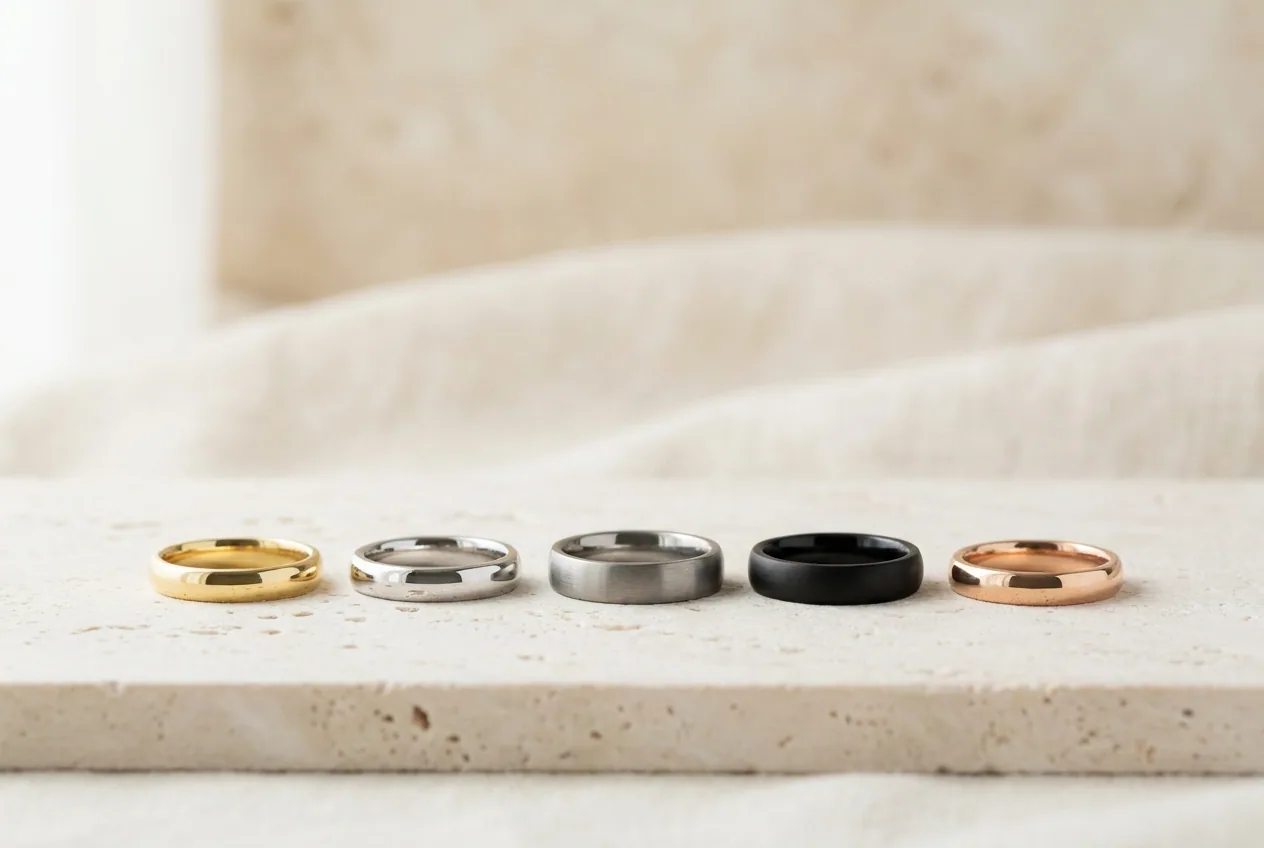
On titanium those marks show least on a satin finish. They are on the surface only, with no plating underneath to wear through. If scratch resistance matters most to you, black zirconium is the ring to look at: its black surface is about 8 on the Mohs scale.
The most durable wedding ring metal: Every metal we make rings in, ranked for scratches and for wear.
Satin, polished or hammered?: How each finish looks and which hides scratches best.
Tungsten or titanium?: The metal that does resist scratches and what it costs you in weight, resizing and removal.
Does a stainless steel or titanium ring rust or tarnish?
Not in ordinary wear, either of them. The British Stainless Steel Association says stainless steel will not corrode in normal atmospheric or water based environments and points to sinks, cutlery and saucepans as the evidence. Its own caution is that stainless does not mean it can never stain: in more aggressive conditions the basic grades may corrode.
316L is the stronger grade here. A steel producer's data sheet says the molybdenum in 316 and 316L improves resistance to chloride corrosion compared with 304, enough for marine atmospheres.
Titanium goes further still. The Royal Society of Chemistry describes its resistance to corrosion in seawater as excellent, which is why it is used in desalination plants and to protect ships' hulls. A titanium ring does not rust or tarnish. It is the same metal all the way through, so it never needs replating.
How to look after a wedding ring: Cleaning, storage and when to take a ring off, metal by metal.
Can a stainless steel or titanium ring be resized or cut off?
Both can be cut off in an emergency. Titanium can also be made a little larger, though never smaller. A 2026 study in the Canadian Journal of Emergency Medicine tried ring cutters on titanium, stainless steel and tungsten carbide rings, 242 attempts in all. The manual cutter kept for gold failed on every ring. A powered cutter removed every one, in all three metals. So on removal the two are equals: tell the doctor or paramedic what the ring is made of and they will choose the right cutter.
Resizing is more limited. Titanium is not cut and rejoined like gold, but the inside of the band can often be machined to make it slightly bigger. It cannot go smaller, so the size is settled when you order and the ring is made to that measurement.
For stainless steel we have found no authoritative published source on resizing, so we make no claim for it either way. The same habit serves both metals: measure first, then order the size you mean to keep.
Can a titanium ring be cut off?: Which cutters go through titanium, with what UK hospitals have published.
Ring size finder: Measure at home in about two minutes, before you order.
Why some rings cannot be resized: Which metals can be made larger or smaller and by how much.
Why does titanium cost more than stainless steel?
Because the metal is harder to win from its ore. The Royal Society of Chemistry gives the reason: titanium costs more than iron because it is more difficult to extract. It is made by the Kroll process, which reduces titanium chloride with magnesium. Stainless steel is mostly iron: in 316L, iron is the balance once the chromium, nickel and molybdenum are counted, roughly two thirds of the alloy.
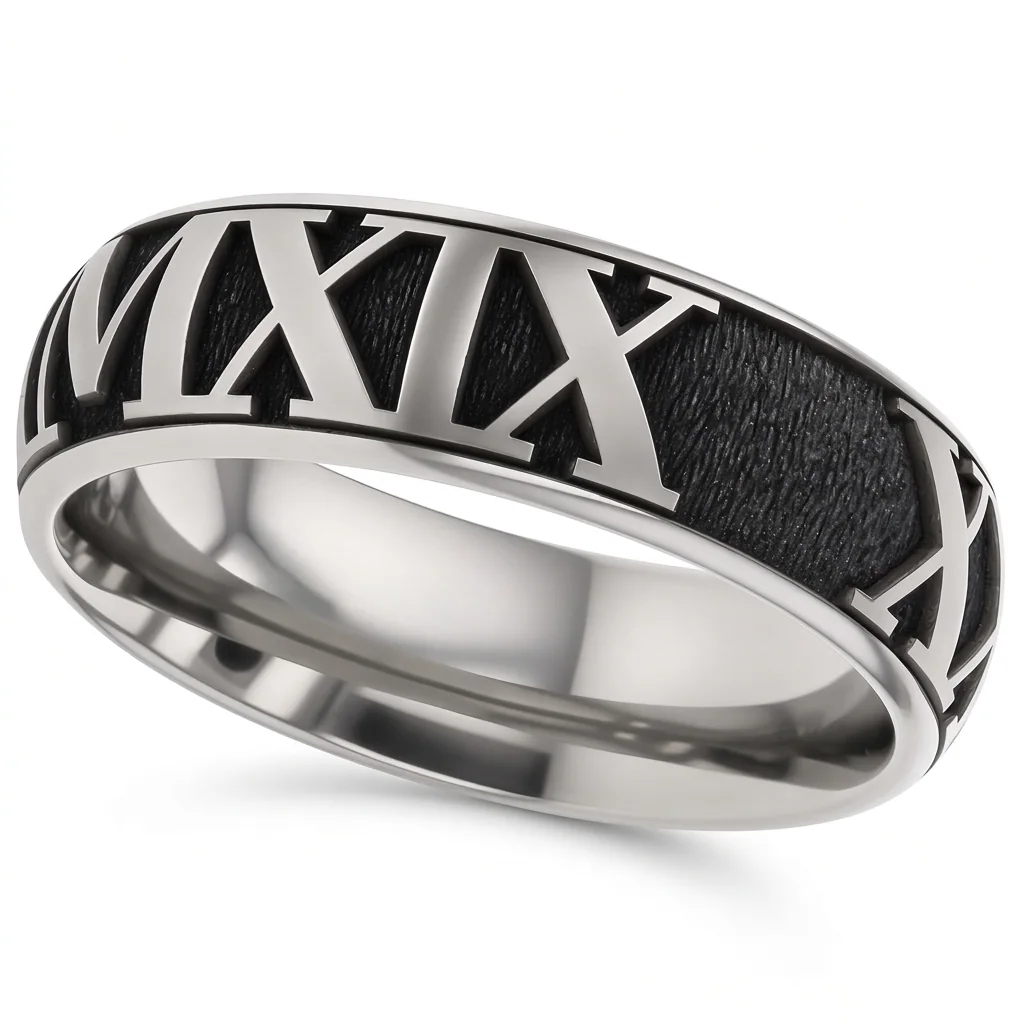
What the difference buys is the lighter ring and one with no nickel in it. Our plain titanium band is also made to order in your size, in widths from 4mm to 10mm, satin or polished, with engraving included.
Titanium is still the least expensive metal we make rings in. The cards on this page show our simplest titanium bands, each with its current price.
Cheapest metal for a wedding ring: The lowest priced ring in each metal we make.
The lower priced rings: The lower priced rings in the range.
Plain titanium: The titanium band at its simplest, in widths from 4mm to 10mm.
Mentioned: titanium.