5 minute read
Wedding ring profiles explained: court, flat court, D-shape and flat
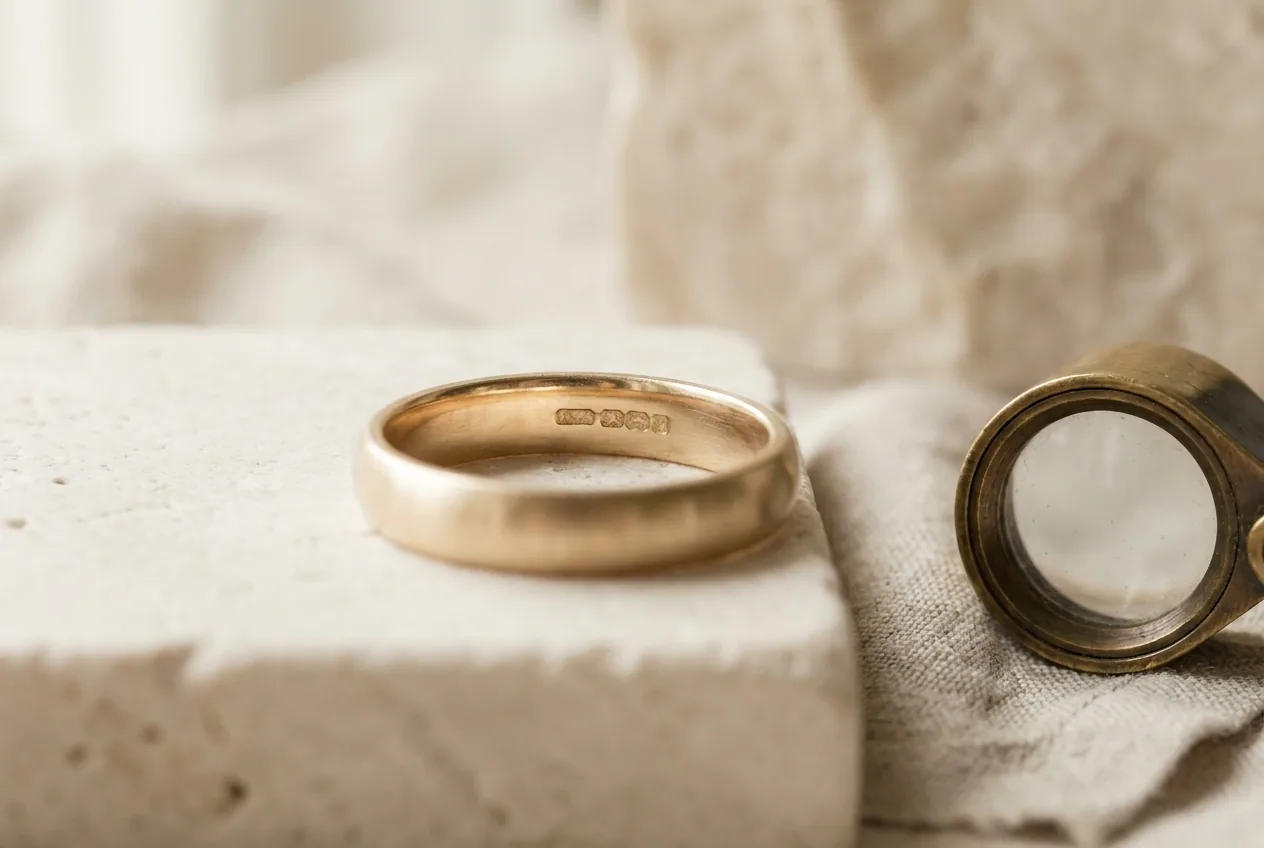
A ring's profile is the shape of the band if you cut through it: rounded or flat on the outside, rounded or flat on the inside. It decides how a ring feels on the finger more than anything except its width. The court, rounded inside and out, is the one most people find most comfortable.

What is a wedding ring profile?
The profile is the cross section of the band: the shape you would see if you cut the ring through and looked at the cut end. Two rings of the same metal and width can feel quite different on the finger because one is rounded inside and the other is flat.
Jewellers describe a profile by its outside and its inside. The outside decides how the ring looks and catches the light. The inside decides how it feels, especially when your fingers swell on a warm day or you bend them to grip something.
Court: rounded inside and out
A court ring is curved on the outside and curved on the inside too. Nothing sits square against the finger, so it slides over the knuckle easily and feels smooth all round. That inner curve is why the court is the profile most people end up choosing.
Because its edges are rounded away, a court band tends to look a little narrower than a flat band of the same width. Our rounded court is a 4mm court in solid gold and the wide court is a 6mm version with a high polish.
Rounded court: 4mm in solid 9ct or 18ct gold, rounded inside and out.
Wide court: 6mm, domed outside with a court inside, high polished.
Flat court: flat outside, rounded inside
A flat court has a flat face with softened edges and a rounded inside. You get the clean, modern look of a flat band with the comfort of a court where it touches your finger. It is a common choice for men's rings and wider bands.
Our plain titanium band is a flat court, rounded inside for comfort, with a satin centre and bright polished edges or polished all over. The black zirconium Roman numeral ring is a flat court too.
Plain titanium: A flat court in 4 to 10mm, rounded inside for comfort.
Raised Roman numerals, black: A flat court black zirconium band carrying your date.
D-shape: domed outside, flat inside
A D-shape ring is domed on the outside and flat on the inside, so the cut end looks like a capital D lying on its back. It is the traditional English wedding ring profile and older than the court, which is why many people picture it when they picture a wedding ring.
The flat inside sits closer to the finger, which some people like because the ring feels secure. Others find it less comfortable than a court over the knuckle. If you are unsure, the court is the safer choice for comfort and the D-shape the more traditional one for looks.
Dome and soft ridge
A dome profile curves up across the whole face of the band, so light runs round it in one smooth line. Several of our titanium and black zirconium rings are dome profile, including the hammered black dome.
A soft ridge rises to a gentle crest along the centre of the band, so the light gathers in a line along the finger rather than spreading across the face. Our soft ridge is a 3mm band in solid gold.
Hammered black dome: A dome profile black zirconium band, hammered all over.
Soft ridge: 3mm in solid gold, rising to a soft ridge.
Flat: a face for patterns and words
A flat profile has a flat outside face, which gives an even surface to cut a pattern, a line or a word into. Many of our patterned titanium rings are flat profile for that reason, from the heartbeat ring to the ring engraved with your two names.
A flat band shows its full width, with crisp edges, so it reads as a little wider and more architectural than a court of the same width.
Heartbeat, titanium: A flat profile band with a heartbeat line cut round it.
Linked names: Your two names cut into a flat profile titanium band.
What does comfort fit mean?
Comfort fit is a description of the inside of a ring, not a separate profile. It usually means the inside is rounded, as in a court or a flat court, so the band rolls over the knuckle instead of catching on it. Ask which profile a comfort fit ring actually is, because the outside can be any shape.
Which profile should you choose?
For comfort above all, choose a court or a flat court: the rounded inside is what you feel every day. For a wider band, especially 6mm and over, a rounded inside matters more, because a wide flat inside presses on more of the finger.
For looks, a court and a dome read soft and classic, a flat court and a flat read modern and crisp and a D-shape reads traditional. If your ring will sit beside an engagement ring, look at the two side by side: a flat edge sits flush against another flat edge, while a rounded edge leaves a slight gap.
The profile does not change your size, but width does. A wider band fits more snugly in the same size. The size finder allows for it.
How to choose a wedding ring: Metal, width, profile, finish and size, in order.
See a ring on your hand first: The try-on, a paper width test and a ring you own.
Mentioned: 9ct gold, titanium, black zirconium.