5 minute read
What 9ct gold means and why it makes a good wedding ring
9ct gold is 37.5% pure gold, hallmarked 375. It is real gold, tested and marked by an assay office. It is also the harder of the two gold alloys rings are usually made in, which is why it suits a ring worn every day.

What is 9ct gold?
9ct gold is an alloy that is 37.5% gold by weight. Carats count gold in 24ths, so 9 carat means 9 parts in every 24 are pure gold, which works out at 375 parts in every thousand. The other 62.5% is a mix of other metals that sets the colour and makes the gold hard enough to wear.
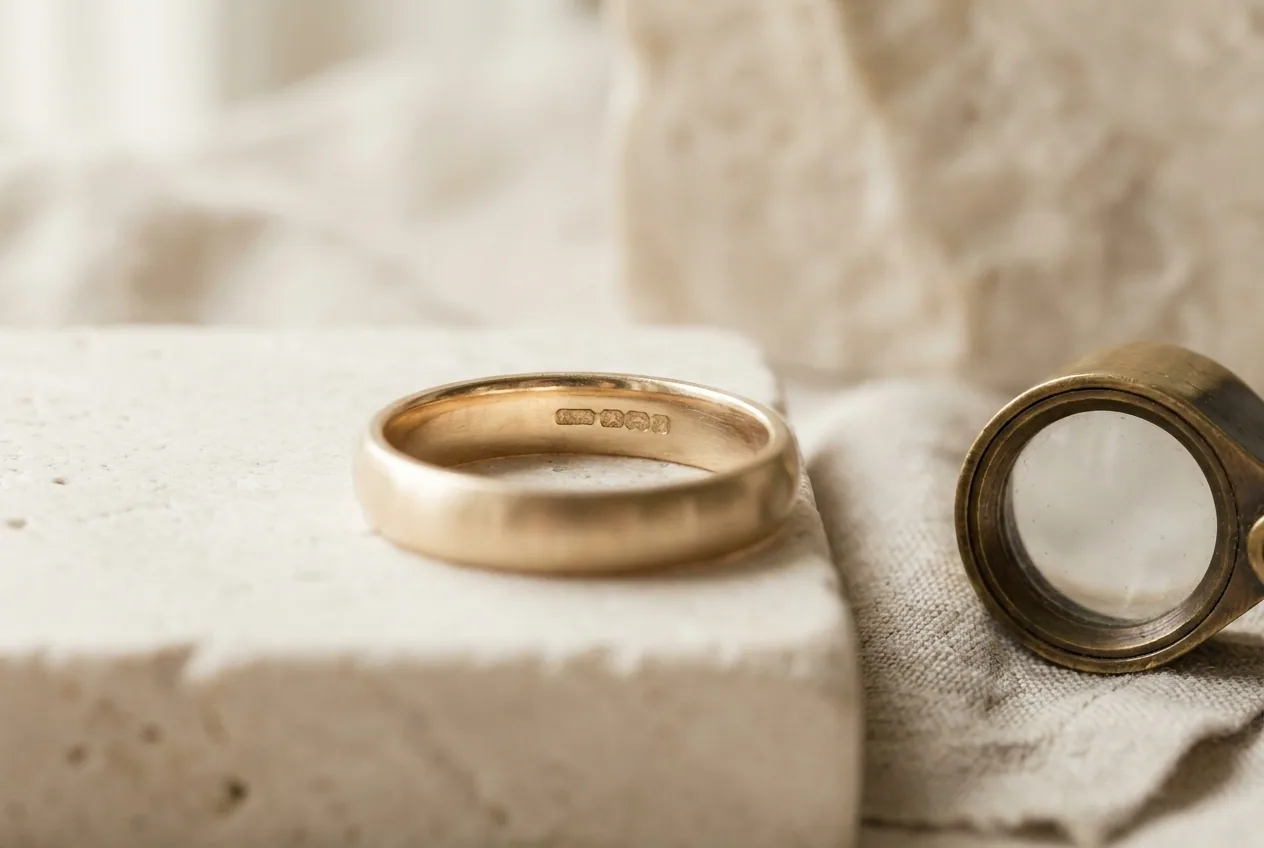
That is why a 9ct ring is stamped 375 rather than 9. A UK hallmark states purity in parts per thousand. The figure is a minimum: an assay office has tested the ring and found at least 375 parts of gold in every thousand before striking the mark.
Gold is hallmarked in Britain at 375, 585, 750, 916, 990 and 999. Those are 9ct, 14ct, 18ct and 22ct, then the two near pure standards. 9ct is the first of them and a British standard that has been sold here for over a century.
UK hallmarks explained: What each mark beside the 375 tells you, which assay office struck it and which rings have to carry a hallmark by law.
Is 9ct gold real gold?
Yes. 9ct is real gold and in Britain the law makes sure of it. Anything sold as gold that weighs more than one gram has to carry a hallmark. Every wedding ring is well over that weight.
A full hallmark has three compulsory parts: the sponsor's mark, which shows who sent the ring for testing; the fineness mark, which is 375 for 9ct; and the mark of the assay office that tested it. A date letter is optional.
So a 375 inside the band is the proof. The hallmark decoder reads the rest of the mark for you, including which of the four UK assay offices struck it.
Hallmark decoder: Enter the numbers and symbols inside a ring and see the metal, its fineness and the assay office that marked it.
Is 9ct gold good for a wedding ring?
Yes. For a ring worn every day it even has an edge over 18ct. It is the harder of the two alloys, about 3.5 on the Mohs scale against 3 for 18ct, so it keeps its finish a little longer on a hand that works. That matters more on a wedding ring than the carat number does.
It is lighter too. A 6mm court band in UK size N comes to about 5.5g in 9ct against about 7.6g in 18ct, from the densities in our ring weight model (11.4 and 15.7 grams per cubic centimetre). Some people like a ring they barely notice. Others want the weight, which is where 18ct earns its place.
And it is real precious metal at a sensible cost. With less gold in the alloy, a 9ct ring costs less than the same ring in 18ct, which counts for more in a year when gold set an all time record.
18ct gold or 9ct gold?: The two side by side: weight at every width, hardness, prices in our range and resizing.
What is 18ct gold?: The richer gold: 75% pure, hallmarked 750, with the deepest colour and the most weight.
What colours does 9ct gold come in?
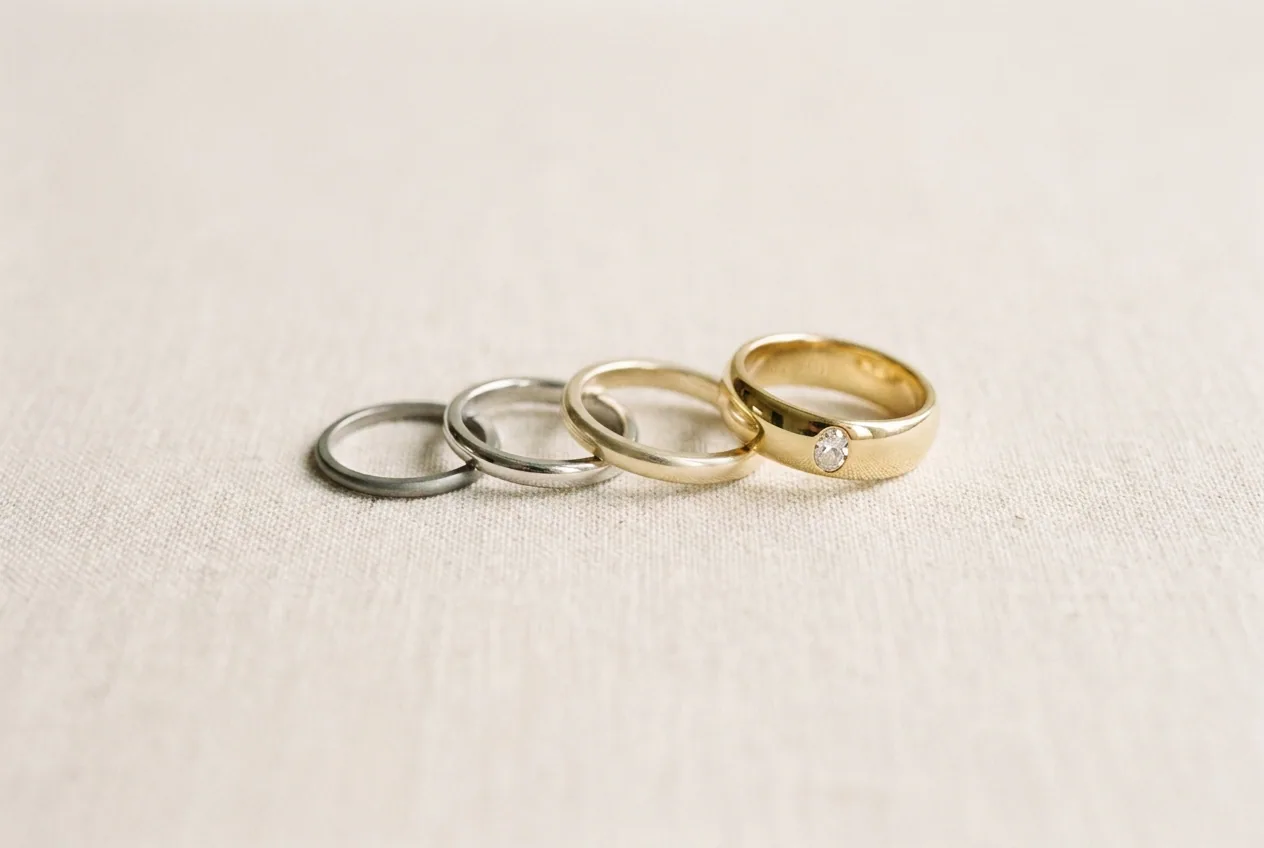
Yellow, white and rose. Our 9ct rings come in all three. The gold content is the same 37.5% in each. The colour comes from the other 62.5%.
In the reference casting alloys our weight model uses, 9ct white is whitened with palladium and is a little heavier than yellow, at 12.6 against 11.4 grams per cubic centimetre. White gold is often plated with rhodium for a brighter white. The plating wears gradually and a jeweller can replate it whenever the ring starts to look warm.
GIA notes that white gold is alloyed with either nickel or palladium. It advises anyone allergic to nickel to avoid the nickel kind. Our guide to metal allergies covers the metals that suit sensitive skin.
Metal allergies and hypoallergenic rings: Which ring metals suit sensitive skin and what to look for in white gold.
Does 9ct gold scratch? Can it be resized?
It marks with wear like all gold. The marks polish out at any jeweller; polishing takes a very small amount of metal each time, so it is an occasional refresh rather than a routine.
Yes, it can be resized. A plain 9ct gold band can be made larger or smaller by a jeweller, the way wedding rings have always been resized. The exception is a band set with stones all the way round, where there is nowhere to cut without disturbing a stone, so on those the size is settled when you order.
It is also the gold in our precious inlay rings. A line of solid 9ct set flush in titanium or black zirconium needs to wear at something like the same rate as the metal around it. The harder alloy does.
Gold rings: Every gold band in our range, in 9ct and 18ct, made to order in your size.
Mentioned: 9ct gold, 18ct gold, platinum 950.