Comparison
18ct gold or Palladium 950?
Choose 18ct gold if you want the richest colour and the weight of 75% gold. Choose palladium 950 if you want the colour of platinum at less than its weight and its price.
- Heavier: 18ct gold, about 1.3 times the weight
- Harder surface: Palladium 950 (Mohs 4.75 against 3)
- From: 18ct gold £689
- Resizing: 18ct gold, yes, by a jeweller; palladium 950, yes, by a jeweller
Checked .
| Side by side | 18ct gold | Palladium 950 |
|---|---|---|
| Surface | Gold alloy, colour varies | Palladium alloy |
| Hardness (Mohs) | 3 | 4.75 |
| Density | 15.7 g/cm³ reference | 12.0 g/cm³ reference |
| 6mm band, size N | about 7.6g | about 5.8g |
| Resizing | Yes, by a jeweller | Yes, by a jeweller |
| Hallmarked | Yes, by law above the exemption weight | Yes, by law above the exemption weight |
| Our rings from | £689 | See the range |
Which is heavier, 18ct gold or palladium 950?
18ct gold is heavier, about 1.3 times the weight of palladium 950 for the same ring. A 6mm band in size N comes to about 7.6g in 18ct gold and 5.8g in palladium 950.
| Width | 18ct gold | Palladium 950 |
|---|---|---|
| 2mm | 2.5g | 1.9g |
| 4mm | 5.1g | 3.9g |
| 6mm | 7.6g | 5.8g |
| 8mm | 10.2g | 7.8g |
Worked out from the reference densities (15.7 and 12.0 g/cm³) with the same model as our ring weight calculator, where you can set your own size, width and thickness. A bigger size adds a little more metal: the size N page and the other size pages give the weights at each size.
Is 18ct gold more expensive than palladium 950?
18ct gold rings start at £689 in our range. Plain palladium 950 bands are not in the range at the moment, and the palladium 950 material page shows what is. Both are precious metals, so the difference is mostly how much gold or platinum is in the ring.
Every ring is made to order in your size, and engraving is free on every ring whose page offers it.
Which is harder wearing?
Palladium 950 has the harder surface: Mohs 4.75 against 3 for 18ct gold, so it picks up fewer everyday marks. 18ct gold marks sooner, and any jeweller can polish it back.
18ct gold. 18ct is 75% gold, which gives it the deepest colour and real weight on the finger. It is a little softer than 9ct, so it shows marks a little sooner, and they polish out at any jeweller. Yellow and rose gold need nothing more; white gold is often rhodium plated, and replating brings back its bright white whenever you want it.
Palladium 950. Naturally white like platinum and hallmarked like it, but noticeably lighter on the finger. It wears much the same way.
Want gold that wears harder? 9ct gold is the harder alloy and costs less than 18ct. Compare 9ct gold and palladium 950
Can 18ct gold and palladium 950 rings be resized?
18ct gold: Yes. A plain 18ct gold band can be made larger or smaller by a jeweller, the way wedding rings have always been resized. The exception is a band set with stones all the way round, where there is nowhere to cut without disturbing a stone, so on those the size is settled when you order.
Palladium 950: Yes. A plain palladium 950 band can be made larger or smaller by a jeweller, the way wedding rings have always been resized. The exception is a band set with stones all the way round, where there is nowhere to cut without disturbing a stone, so on those the size is settled when you order.
Either way, getting the size right first is the easy part: the free ring size finder measures it at home in a couple of minutes, and the resizing guide explains the differences between metals.
Sensitive skin and hallmarks
18ct gold is a gold alloy, and white gold can be alloyed with nickel, so if you know you react to nickel, a hypoallergenic metal such as platinum, titanium or zirconium is the easy choice. Palladium 950 is hypoallergenic and a common choice for sensitive skin. The metal allergy guide explains what causes a rash under a ring.
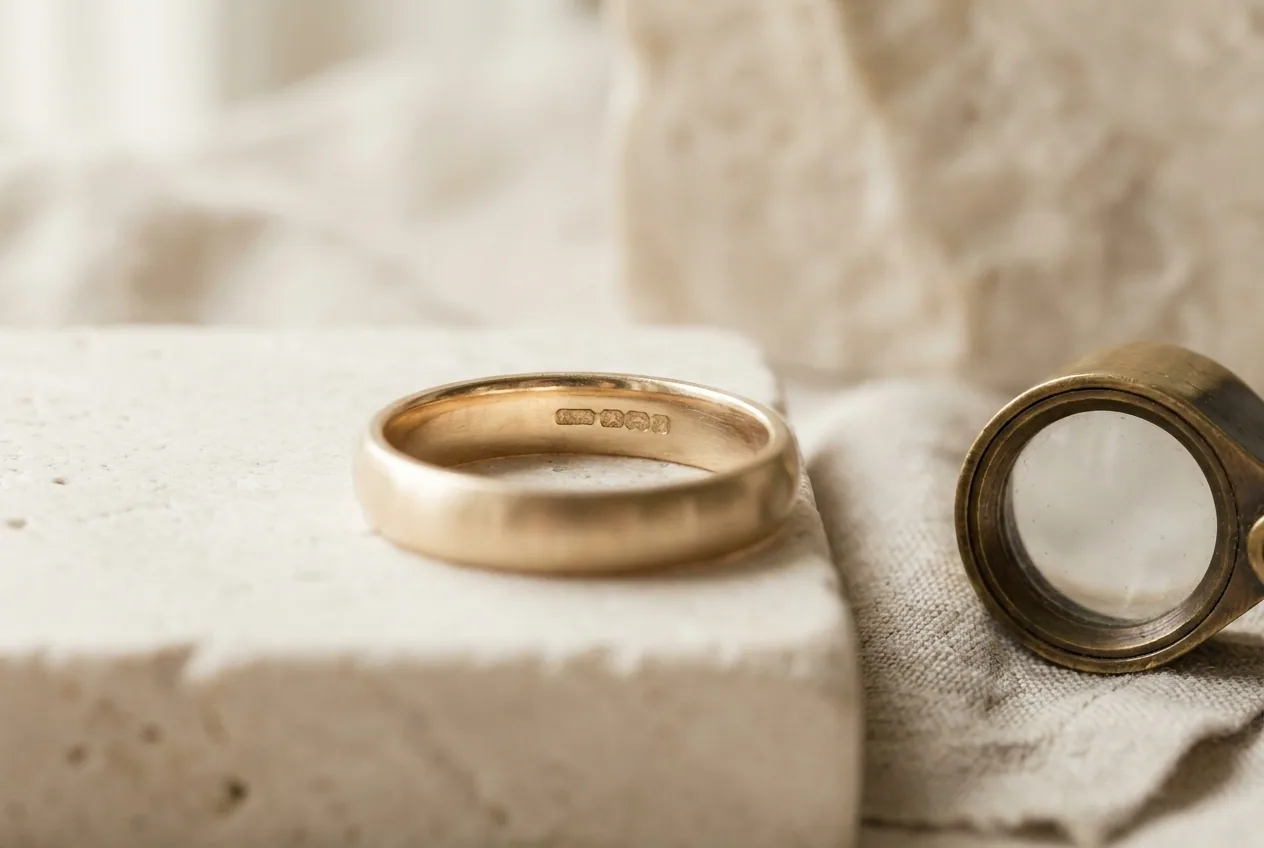
Gold, silver, platinum and palladium are hallmarked by law above the exemption weights. The marks go inside the band, where you can read the fineness for yourself. The UK hallmarking guide explains each mark.
Our verdict
18ct gold if you want the richest colour and the weight of 75% gold. Palladium 950 if you want the colour of platinum at less than its weight and its price.
Not sure on width? The band width guide shows what each width looks like and weighs, and the metal chooser weighs the metals up against how you will wear the ring.
In these materials
Rings to look at
Rings made in, or available in, the two materials above, each with its current price, widths and finishes on its own page.

Slim band
Two millimetres of solid gold, narrow enough to sit close to an engagement ring.

Soft ridge
The face rises to a gentle ridge, so the light runs along the finger.

Rounded court
Rounded outside and rounded inside, which is the comfortable one.
Explore the fit and weight

Common questions
- Is 18ct gold or palladium 950 harder wearing?
- Palladium 950 has the harder surface: Mohs 4.75 against 3 for 18ct gold, so it picks up fewer everyday marks. 18ct gold marks sooner, and any jeweller can polish it back.
- Is 18ct gold heavier than palladium 950?
- 18ct gold is heavier, about 1.3 times the weight of palladium 950 for the same ring. A 6mm band in size N comes to about 7.6g in 18ct gold and 5.8g in palladium 950.
- Is 18ct gold more expensive than palladium 950?
- 18ct gold rings start at £689 in our range. Plain palladium 950 bands are not in the range at the moment, and the palladium 950 material page shows what is. Both are precious metals, so the difference is mostly how much gold or platinum is in the ring.
- Can both be resized?
- Yes. A plain 18ct gold band can be made larger or smaller by a jeweller, the way wedding rings have always been resized. The exception is a band set with stones all the way round, where there is nowhere to cut without disturbing a stone, so on those the size is settled when you order. Yes. A plain palladium 950 band can be made larger or smaller by a jeweller, the way wedding rings have always been resized. The exception is a band set with stones all the way round, where there is nowhere to cut without disturbing a stone, so on those the size is settled when you order.
- Are both hallmarked?
- Gold, silver, platinum and palladium are hallmarked by law above the exemption weights. The marks go inside the band, where you can read the fineness for yourself.