Comparison
Platinum 950 or Precious inlay?
Choose platinum 950 if you want a white metal that stays white on its own, with no plating to renew. Choose precious inlay if you want real hallmarked gold on the ring without paying for a solid gold one.
- Harder surface: Precious inlay (Mohs 8.5 against 4.5)
- From: precious inlay £385
- Resizing: platinum 950, yes, by a jeweller; precious inlay, slightly larger
Checked .
| Side by side | Platinum 950 | Precious inlay |
|---|---|---|
| Surface | Platinum alloy | Two metals in one band |
| Hardness (Mohs) | 4.5 | 8.5 |
| Density | 20.1 g/cm³ reference | Varies by design |
| Resizing | Yes, by a jeweller | Slightly larger |
| Hallmarked | Yes, by law above the exemption weight | Yes, by law above the exemption weight |
| Our rings from | See the range | £385 |
Which is heavier, platinum 950 or precious inlay?
An inlay ring weighs what its titanium or zirconium base weighs plus a little for the gold line, so it sits much closer to the base metal than to solid gold. Every ring page gives the weight of that band.
Is platinum 950 more expensive than precious inlay?
Precious inlay rings start at £385 in our range. Plain platinum 950 bands are not in the range at the moment, and the platinum 950 material page shows what is. An inlay ring carries a line of solid gold rather than a whole band of it, which is why it costs less than platinum 950.
Every ring is made to order in your size, and engraving is free on every ring whose page offers it.
Which is harder wearing?
Precious inlay has the harder surface: Mohs 8.5 against 4.5 for platinum 950, so it picks up fewer everyday marks. Platinum 950 marks sooner, and any jeweller can polish it back.
Platinum 950. Platinum is naturally white, so there is no plating to renew. It does scratch, but a scratch moves the metal rather than removing it, so over time the surface settles into a soft patina instead of wearing thin. A jeweller can burnish it back to a bright shine, which GIA describes as the gentle way to restore worn platinum.
Precious inlay. Solid gold set flush into a titanium or zirconium band and hallmarked at Birmingham. The two metals wear at different rates, so the gold picks up marks first, and it polishes back. The inlay is a few millimetres of gold, not a gold ring, and we give the weight on every product page.
Platinum and patina. A platinum ring dulls to a soft satin over the years rather than wearing thin. Some people love that look; a jeweller burnishes it back to a mirror shine for anyone who does not.
Can platinum 950 and precious inlay rings be resized?
Platinum 950: Yes. A plain platinum 950 band can be made larger or smaller by a jeweller, the way wedding rings have always been resized. The exception is a band set with stones all the way round, where there is nowhere to cut without disturbing a stone, so on those the size is settled when you order.
Precious inlay: Often, a little larger. On a titanium base the inside of the band can be machined to make it slightly bigger, though not smaller, and it is never stretched, so the inlay stays exactly as it was made. On a black zirconium base the colour is grown into the surface, so the size is settled when you order and the ring is made to it.
Either way, getting the size right first is the easy part: the free ring size finder measures it at home in a couple of minutes, and the resizing guide explains the differences between metals.
Sensitive skin and hallmarks
Platinum 950 is hypoallergenic and a common choice for sensitive skin. Precious inlay is hypoallergenic and a common choice for sensitive skin. The metal allergy guide explains what causes a rash under a ring.
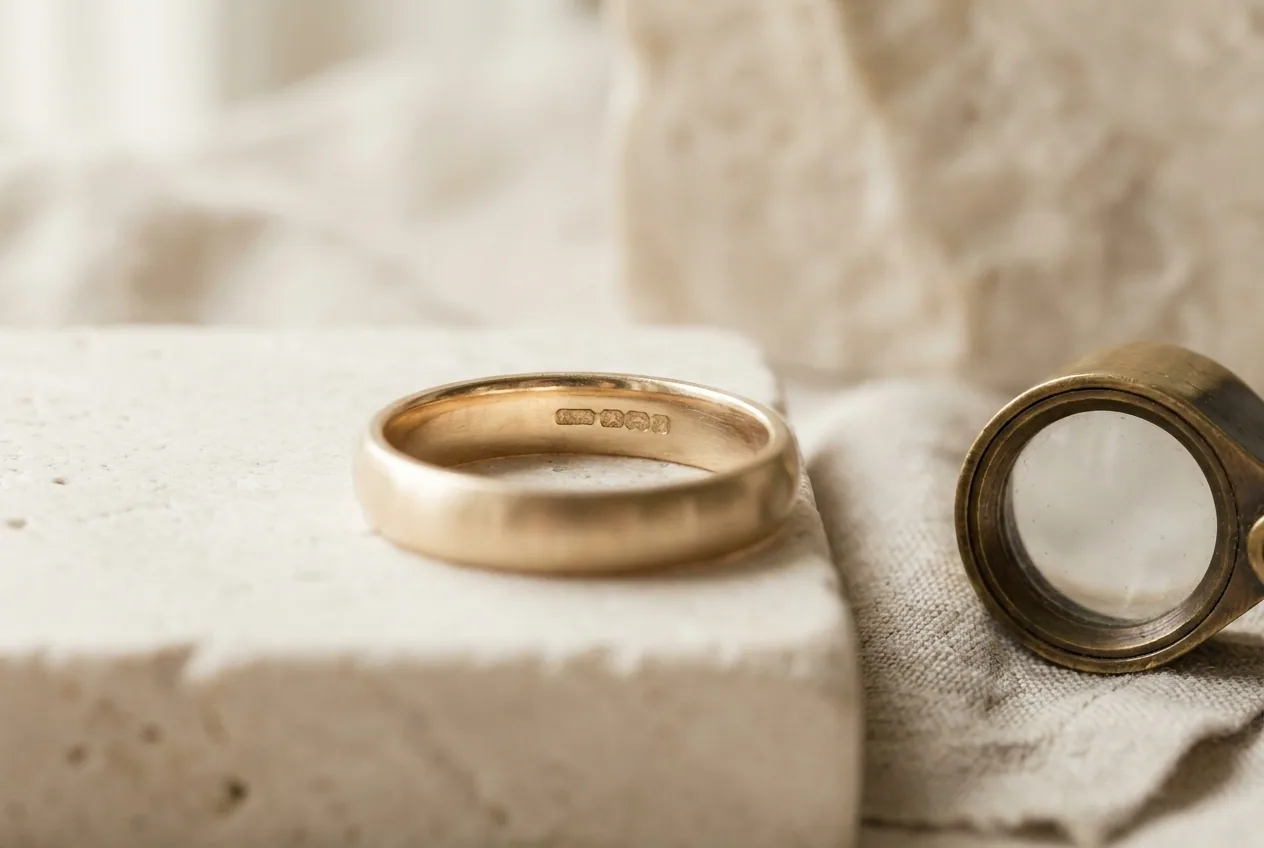
Gold, silver, platinum and palladium are hallmarked by law above the exemption weights. The marks go inside the band, where you can read the fineness for yourself. The UK hallmarking guide explains each mark.
Our verdict
Platinum 950 if you want a white metal that stays white on its own, with no plating to renew. Precious inlay if you want real hallmarked gold on the ring without paying for a solid gold one.
Not sure on width? The band width guide shows what each width looks like and weighs, and the metal chooser weighs the metals up against how you will wear the ring.
In these materials
Rings to look at
Rings made in, or available in, the two materials above, each with its current price, widths and finishes on its own page.

Lab grown diamond solitaire
Four claws, one certified diamond, grown rather than mined.

Gold line, titanium
Solid gold inlaid down the centre of brushed titanium.

Natural diamond solitaire
A mined diamond with a GIA report, chosen one stone at a time.
Explore the fit and weight

Common questions
- Is platinum 950 or precious inlay harder wearing?
- Precious inlay has the harder surface: Mohs 8.5 against 4.5 for platinum 950, so it picks up fewer everyday marks. Platinum 950 marks sooner, and any jeweller can polish it back.
- Is platinum 950 heavier than precious inlay?
- An inlay ring weighs what its titanium or zirconium base weighs plus a little for the gold line, so it sits much closer to the base metal than to solid gold. Every ring page gives the weight of that band.
- Is platinum 950 more expensive than precious inlay?
- Precious inlay rings start at £385 in our range. Plain platinum 950 bands are not in the range at the moment, and the platinum 950 material page shows what is. An inlay ring carries a line of solid gold rather than a whole band of it, which is why it costs less than platinum 950.
- Can both be resized?
- Yes. A plain platinum 950 band can be made larger or smaller by a jeweller, the way wedding rings have always been resized. The exception is a band set with stones all the way round, where there is nowhere to cut without disturbing a stone, so on those the size is settled when you order. Often, a little larger. On a titanium base the inside of the band can be machined to make it slightly bigger, though not smaller, and it is never stretched, so the inlay stays exactly as it was made. On a black zirconium base the colour is grown into the surface, so the size is settled when you order and the ring is made to it.
- Are both hallmarked?
- Gold, silver, platinum and palladium are hallmarked by law above the exemption weights. The marks go inside the band, where you can read the fineness for yourself.